Slack Water is a prototype and an experiment. Can one person and a crew of parallel Claude Code sessions make a real game together, from story and puzzles to engine, art and testing, with the person deciding and the sessions doing the work? This is the report.
Form HG-2
Section 1 · Summary of findings
Accession record: the experiment
Two questions: does the collaboration work at every stage, and does the technical path (generated art and animation, Godot, touch on iOS) hold up?
Slack Water is a small point-and-click comedy: six rooms, seventeen puzzles, thirty to forty minutes, built in Godot for iPhone and iPad. Jeff Woods is the only person on the project and makes the decisions. Parallel Claude Code sessions, each with its own job and files, do most of the writing, coding, art direction and testing.
This report covers about 74 hours, 9 to 12 November 2026: 2,108 commits on main from about 185 to 190 sessions. Sessions are short-lived on purpose. When one fills its context, it writes a handover and a successor takes over.
One rule holds it together: the game is compiled from plain-text design files. No puzzle or story logic lives in engine code, and a checker plays the whole game after every design change. The numbers below are from its latest run.
10,213States explored0Softlocked48Steps to win17Puzzles126Hotspots
Form HG-3 · Schedules A and B
Section 2 · Schedule A, the premises
A crew of one, at many desks
One desk per kind of work, one owner per file, and every message routed through the front desk.
Every session belongs to an area. Main keeps the spec, the decision log and the merges. Engine builds the Godot runtime and its QA. Design-tools owns the checker and solver. Story owns the world files, the dialogue and every line of text. Art owns the generation pipeline and every picture. Promo writes reel scripts and store copy, and music is parked.
A session edits only the files its area owns, listed in a table in CLAUDE.md. Changes to another area's files go to the owner as a request. Side sessions don't ask Jeff directly: they send main the question with a recommended answer and keep working.
Schedule A. Tap a desk for its card. Dotted lines are messages, and all of them go through main.
Schedule B · Persons and sessions on the premises
Occupant
Kind
Sessions
J. Woods
Person
1 (the only one)
Main
Session
main-2 to main-26
Engine
Session
engine-2 to engine-42
Art
Session
art-1 to art-26, incl. art-8b to 8z
Story
Session
story-2 to story-37
Design-tools
Session
design-tools-2 to 13
Music
Session
music-2 to music-5 (parked)
Promo
Session
promo-1 to promo-2
Research
Pigeonhole
anyone, append-only
Total: about 185 to 190 named sessions. 2,108 commits on main.
Form HG-4
Section 3 · The design files
The script is the source
Rooms, puzzles, items, dialogue and text live in plain-text design files, and the game is compiled from them. The engine doesn't know any puzzle by name.
Everything the player sees is in design/: the bible, YAML files for characters, rules, rooms and puzzles, a dialogue file per character, and all text keyed by ID in text/en.yaml. If a puzzle needs something the format can't express, the format and the checker are extended together. Puzzle logic in a script is a bug.
The format is a numbered spec, 69 items long. Twenty-seven items quote Jeff, so each rule keeps its reason. Puzzles, text and art are separate layers. A missing line or picture shows as a labelled placeholder and goes on a to-do list. It never crashes the game.
A puzzle entry has more than its solution: why the character wants it, why it works in the story, the hints that point to it (each scored for directness), the wrong tries and their replies, and the rejected designs with reasons. Here is one from Act 1.
Copy
design/world/puzzles.yaml · lines 55–85
p_glenn_crate:
  type: ordinary_use
  room: r_green
  door: "A crate on Glenn's stage reads GUS, THIS SIDE UP, and Glenn won't open it before dawn"
  player_goal: "Get Glenn to open the crate"
  goal_told_by: c_glenn
  why: c_glenn.w_glenn_headliner
  leverages: [w_glenn_headliner, w_roland_map]
  needs: []
  solve: {verb: use, item: i_permit, target: [h_crate, h_glenn]}
  exposition:
    - {by: c_glenn, text: glenn.crate_refuse}
  resolution: {text: glenn.lantern}
  handover: {item: i_permit, text: roland.permit_give}
  effects: [take:i_permit, set:f_crate_open, dialogue:glenn#_crate_open]
  because: "Roland wrote the festival permit himself, his first, and section 4 bans unlisted exhibits on a licensed stage. A crate marked GUS is an exhibit until somebody opens it."
  explain_line: p_glenn_crate.explain
  signposts:
    - {text: r_green.h_crate.look, directness: 2, distance_rooms: 0, channel: tap}
    - {text: glenn.crate_refuse, directness: 2, distance_rooms: 0, channel: dialogue}
    - {text: roland.permit_section4, directness: 2, distance_rooms: 0, channel: dialogue}
    - {text: glenn.crate_rules, directness: 2, distance_rooms: 0, channel: dialogue}
    - {text: roland.permit_crate, directness: 3, distance_rooms: 0, channel: dialogue}
    - {text: i_permit.look, directness: 2, distance_rooms: 0, channel: look}
  wrong_tries:
    - {item: i_permit, target: h_roland, line: p_glenn_crate.wrong_roland, nudge: 2}
    - {item: i_permit, target: h_stage, line: p_glenn_crate.wrong_stage, nudge: 1}
    - {item: i_notice, target: h_crate, line: p_glenn_crate.wrong_notice, nudge: 1}
  rejected:
    - "Prying it open: Wren would have to explain it to Glenn, and Glenn would cry."
    - "Roland storming over on his own: then the permit is Roland's puzzle, not Wren's."
design/dialogue/glenn.dialogue · line 11
Glenn: Not before dawn, Wren! It's a surprise! Biggest night in Slack's Cove history! [#id=glenn.crate_refuse]
compiled to
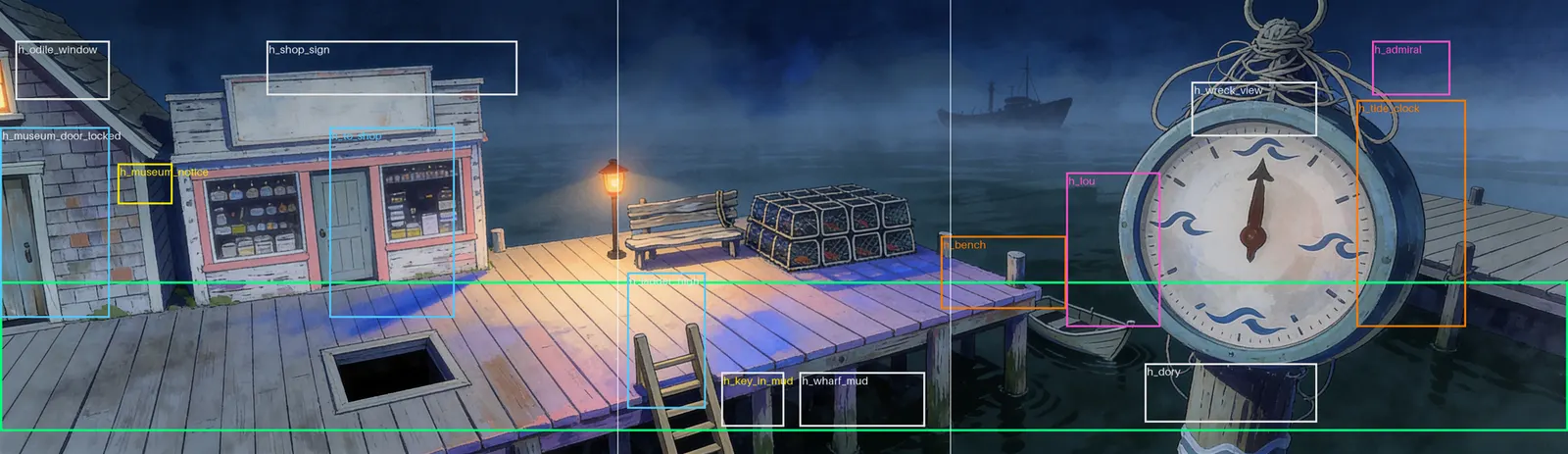
The wharf with its hotspots drawn over it. The rectangles come from rooms.yaml, the picture from the art pipeline, joined by ID.
Form HG-5
Section 4 · Verification
The solver plays it first
Every design change runs a checker that plays every reachable state of the game and rejects the change if any of them is a dead end.
tools/design/check.py runs on every change to design/, and a failure blocks the merge like a failing test. It compiles the design into a state machine and tries every action in every reachable state: 10,213 states right now. The shortest win is 48 steps, the same as the intended path, so no puzzle can be skipped. None of the states is a softlock (a position where the game can't be won).
The tide only changes when the player moves it, never on a timer, so the solver doesn't have to model waiting.
Drag sideways for the rest →
The checker's dependency chart. Numbers are the order on the intended path. Arrows run from what a puzzle needs to what it opens. Spoiler labels are withheld.
The checker also does the checks nobody would do by hand. It scores each puzzle's hints (directness times two, minus rooms of distance, plus two for a reminder) and flags puzzles whose hints are vague, far away and never repeated. After Jeff's first playtest (“your hint dialogs went too far”) it caps hints that give the answer away at two per puzzle. It holds speaker colours to WCAG 4.5:1 contrast and keeps speakers at least ΔE 20 apart. It writes the dependency chart and the art manifest. The design tools have 740 tests of their own.
The solver has played Slack Water more times than anyone ever will. It has never asked for a hint.
Form HG-6
Section 5 · The runtime
A thin engine with a tide in it
A generic Godot runtime reads the compiled design and runs the game. QA tests it only through touch input, the way a finger would.
The runtime is a Godot 4 app in typed GDScript. It knows nothing about the story. It handles parallax rooms and the camera, dialogue, close-ups, the inventory and the tide.
Exhibit A · The tide
Any layer or hotspot can have a condition like tide:low. When the tide turns, the low-water layers wipe in and anything that only exists on the mud appears. The wharf on the game page uses a JavaScript copy of the engine's parallax code, and you can turn the tide there.
Anything without art yet is drawn as a card with its ID on it, like this one, and goes on the to-do list. Right now 15 of 170 art IDs are missing. The game still runs.
[missing art: item_kraken_tooth]TO DO
A placeholder card with its asset ID.
Exhibit C · The finger
QA never reaches into the game's internals. Tours drive it with real taps, drags, holds and flings. An escape sweep checks that every screen can be left by touch. A touch probe fails any button that fires twice from one iOS touch. There are 82 QA scenarios and 1,437 passing unit tests.
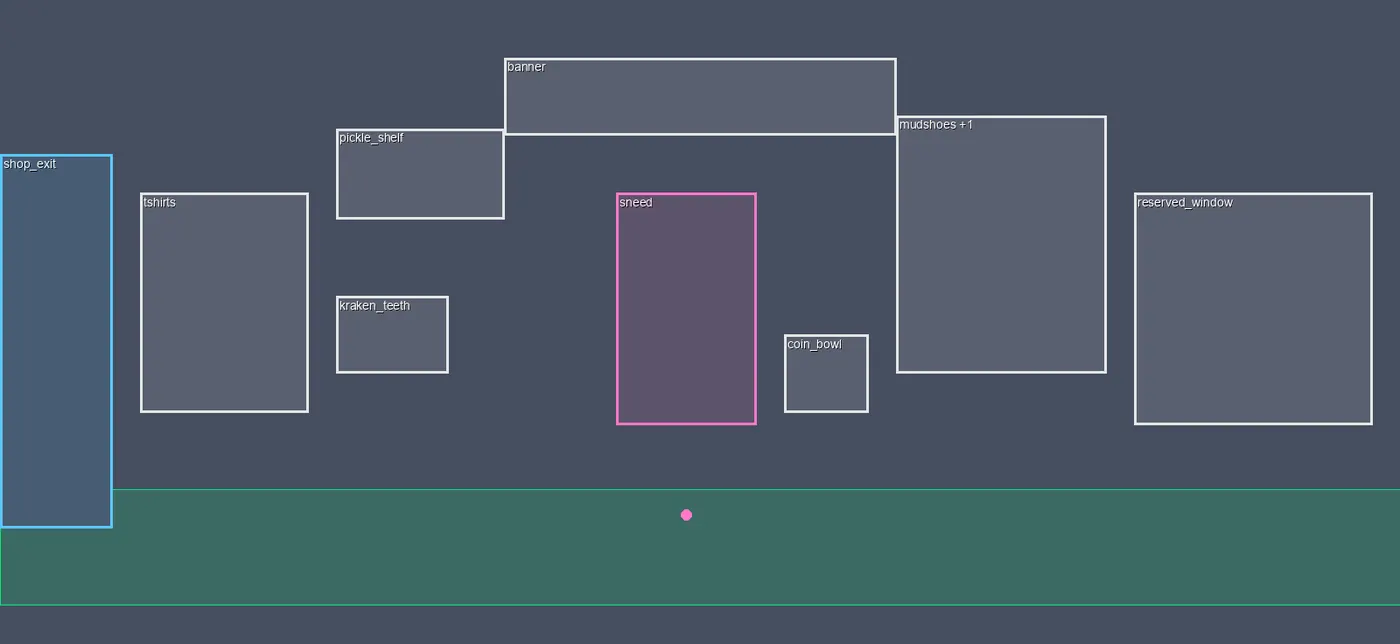
The shop's room brief with a tour's taps drawn over it: walk, t-shirts, pickle shelf, Sneed, coin bowl, mudshoes.
The first phone playtest found a problem the desktop didn't: every animation switch decoded about 110 MB of frames. Wren's frames went from 469 MB to 66.5 MB of memory.
Form HG-7
Section 6 · Intermediaries
Paperwork for a crew of one
A decision log, an ownership map, critic rounds, handovers and review pages let one person steer a dozen sessions without reading everything they write.
The project runs on short documents built to be read fast and acted on. They're the interface between Jeff and the sessions, and between sessions. So far: 385 note files, including 99 handovers, 88 briefs and 84 critic reports.
Decision log
docs/decisions.md: 33 decisions, each dated, marked tentative or firm, and credited to whoever made it.
21. Art mashup recipe: Monkey Island for technique, Wes Anderson for framing, Sam & Max for one deadpan, comically oversized object per room … mustard reserved for Wren. Jeff, from the art-director audit
26. Painted signage is allowed: business names on storefronts, the ON AIR booth sign and similar short signs. Firm. Jeff (“on air is fine!”)
Ownership map
A table in CLAUDE.md: each area, its owner, its files, and what others may do there. Lists hold one entry per line so parallel edits merge cleanly.
Every file has one owner.
Critic rounds
At each milestone main runs critics for story, puzzles, tech, art and UI. Each finding names a file, a fix and an owner, who answers fixed, disputed or needs another owner. 84 critic reports so far.
CriticalHigh
Critics can't edit an owner's files.
Handovers
At about 250k tokens of context, a session writes a handover note and commits a three-line marker. A standby successor watching for it takes over. 99 handovers so far.
Claim ticketHANDOVER-READY-<area>.mdNo. 99
Briefs
Main writes each session a brief naming exact files and IDs, so the session doesn't spend its context reading big files. 88 briefs so far.
Review pages
Jeff doesn't read YAML. He reads the story as a formatted script, drags hotspots in a room editor, and gets renders and audio in an A/B player instead of file paths.
Keep-alive
A cron checks at :17 and :47 past the hour that main and its sessions are still moving. No session waits more than 30 minutes on another.
Form HG-8 · Specimens
Section 7 · Tissue samples
Matte, cut, rig: art and animation
Generated paintings become parallax room layers and cut-out characters. Every paid call goes through a ledger with a hard cap.
All the art is generated. The pipeline makes it behave like game assets: one style, clean edges, loops that don't jump, and a known cost before each batch. Each paid batch runs as a sample, then a critic review, then the batch, under a cap Jeff approves. Art has cost $20.80 so far.
Specimen 7-A · Style search
The style search: candidate looks for Wren and the backgrounds, judged by an art-director critic. Blue-grey fog, one dusty accent, mustard for Wren only.
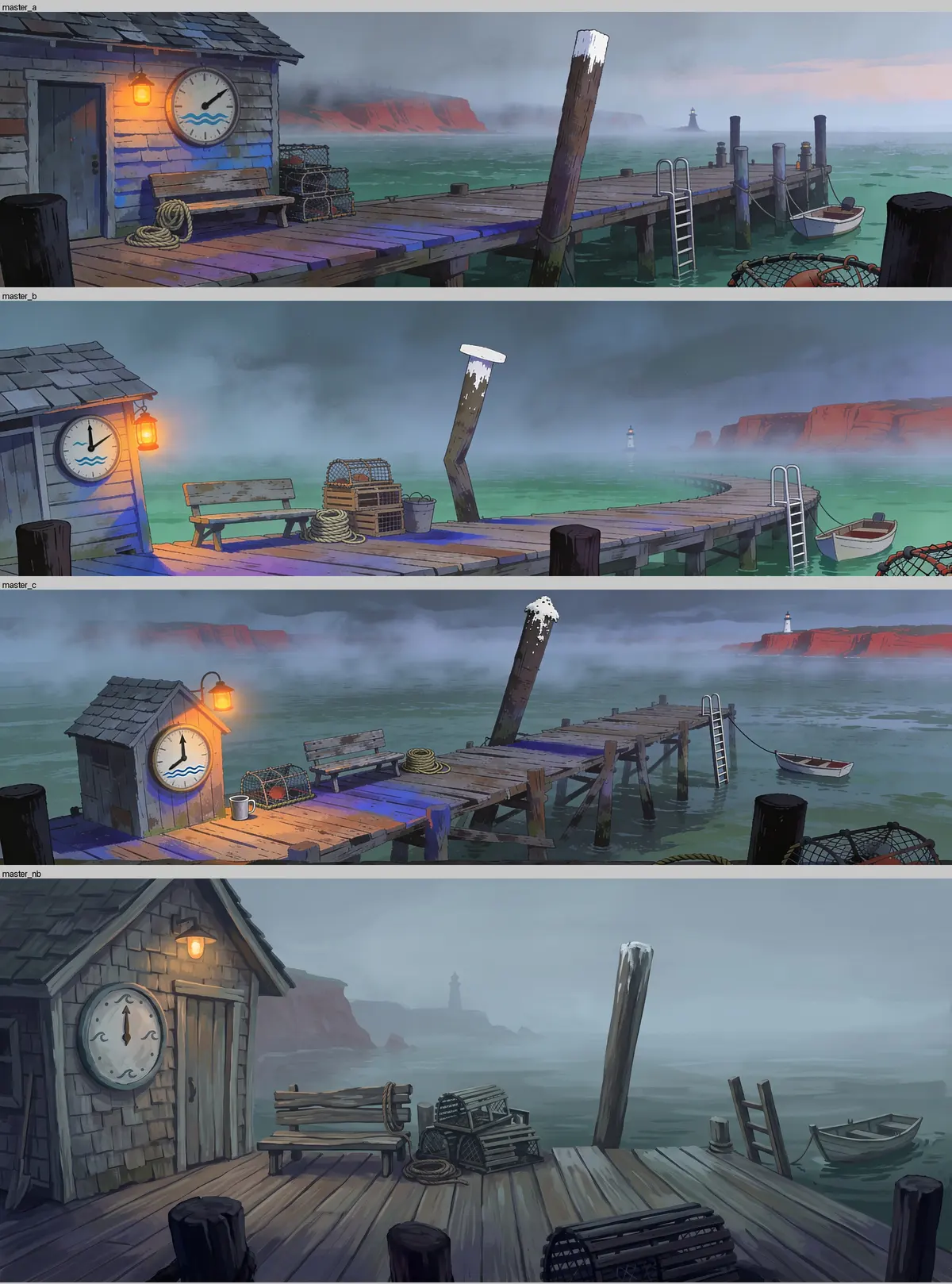
Specimen 7-B · One master per room
Each room starts as one painting. The parallax layers are edits of it, so they share light, palette and perspective. A room costs about $0.70.
Characters animate from video. A still goes to an image-to-video model (Wan 2.2) with a prompt for the action. The pipeline picks the loop point (the frame that best matches frame 0), removes drift, cuts out every frame and cleans the edges. A loop costs $0.11 to $0.16. The game has 32 loops, 1,564 frames.
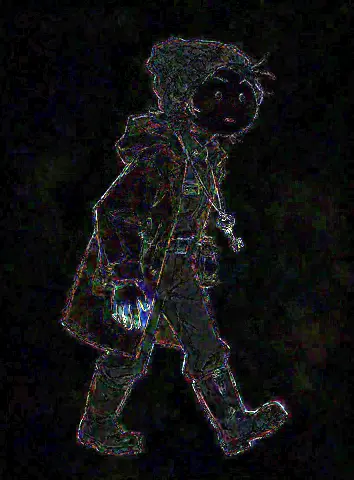
What the model returned, the loop the game plays (every fifth frame), and the difference between the first frame and the loop point. That small difference is why the seam doesn't show.
The video matte was MatAnyone, which keeps edges steady between frames but has a non-commercial licence. The default is now ToonOut (MIT). Stills use the macOS Vision matte.
Gates run before anything ships. art_check.py checks every cut edge on cream and on navy, where halos show. flicker.py fails loops whose edges shimmer. mouthlock.py fixes idle loops where the model makes characters mouth words: it pastes frame 0's closed mouth into every frame.
Specimen 7-D · Edge gate, under the loupe
Edge-gate crops from the wharf: each edge on cream (left) and navy (right). Tap or hover to zoom. An edge passes when neither shows a fringe.
Specimen 7-E · The rig, declined
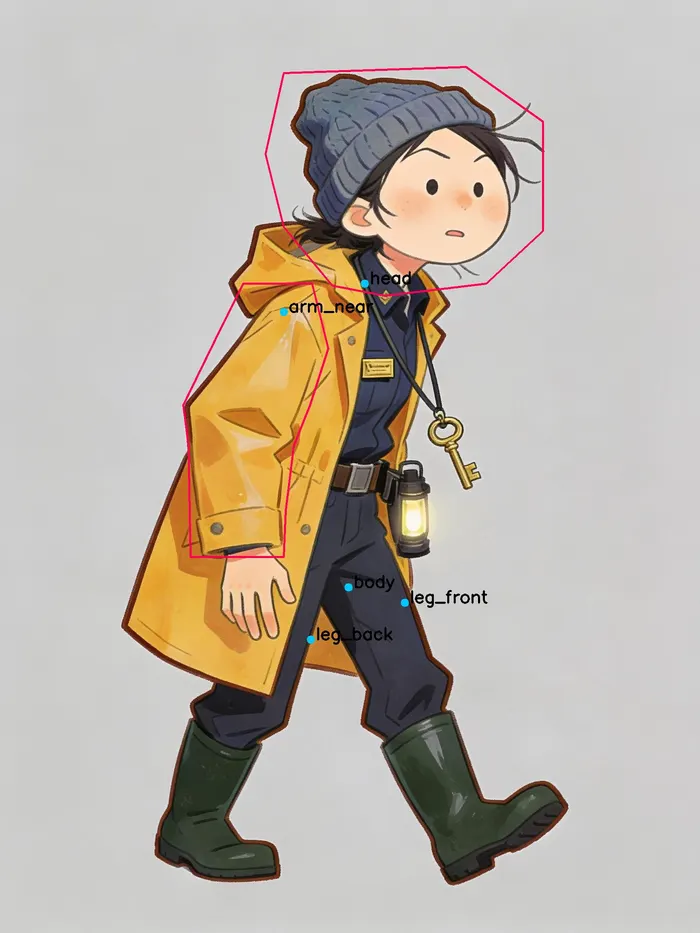
The first plan was a cut-out rig that animated body parts. It was built and dropped. The verdict on the rigged walk was “a scissor”. Video loops replaced it.
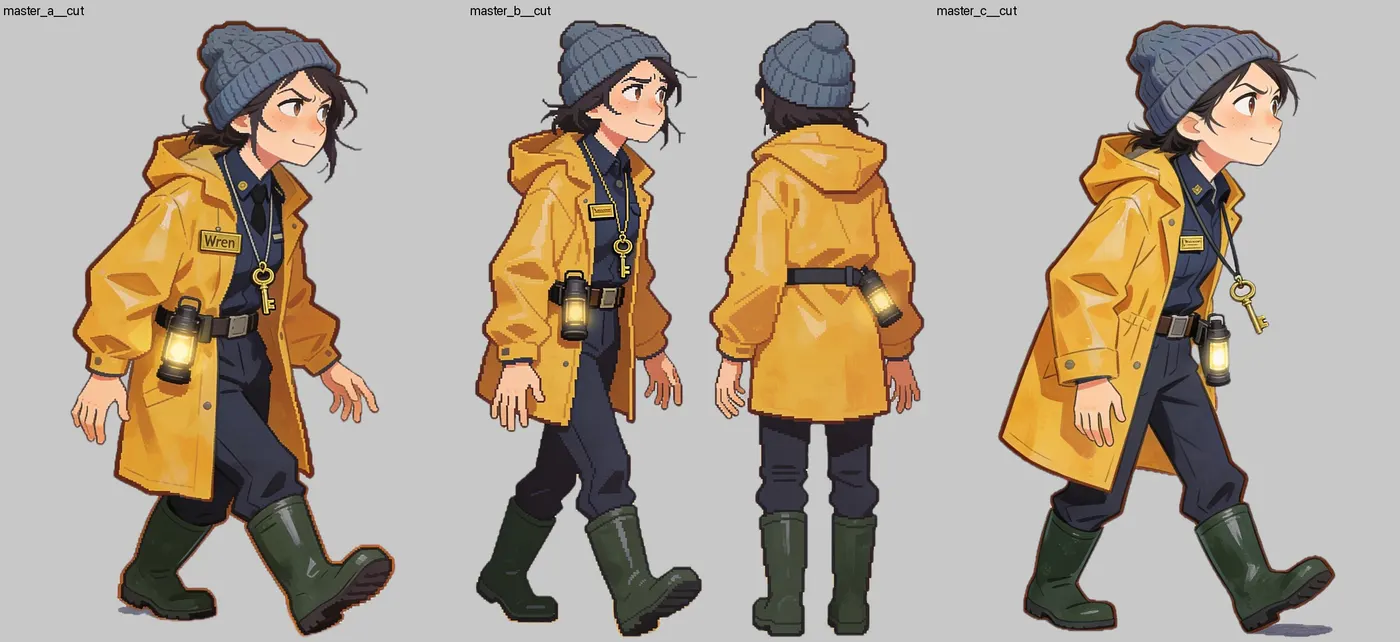
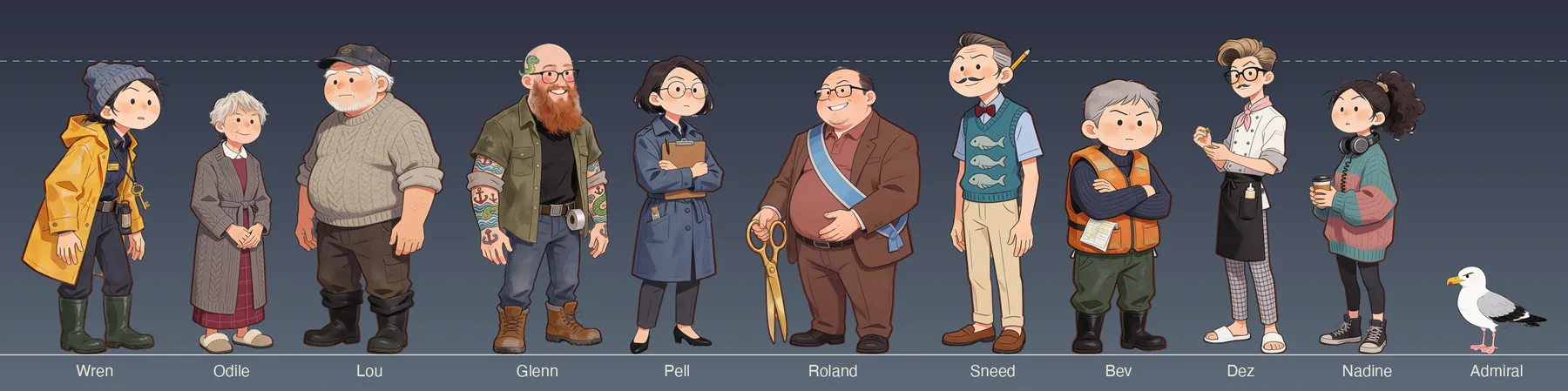
Specimen 7-F · The cast, against one line
Withheld, form HG-7(c)
Every character at game scale, checked against one line so the cast reads as one set. One subject declined to be photographed.
Schedule C · Paid generation, art
Model (Replicate)
Used for
Spent
nano-banana
edits: poses, signs, crop fixes
$9.51
wan 2.2 i2v
character video
$6.16
seedream 4.5
master paintings
$4.48
seedance
image-to-video, cheap tier
$0.65
Total, art
$20.80
Music, parked (not art)
$10.08
Specimen 7-G · The wharf, taken apart
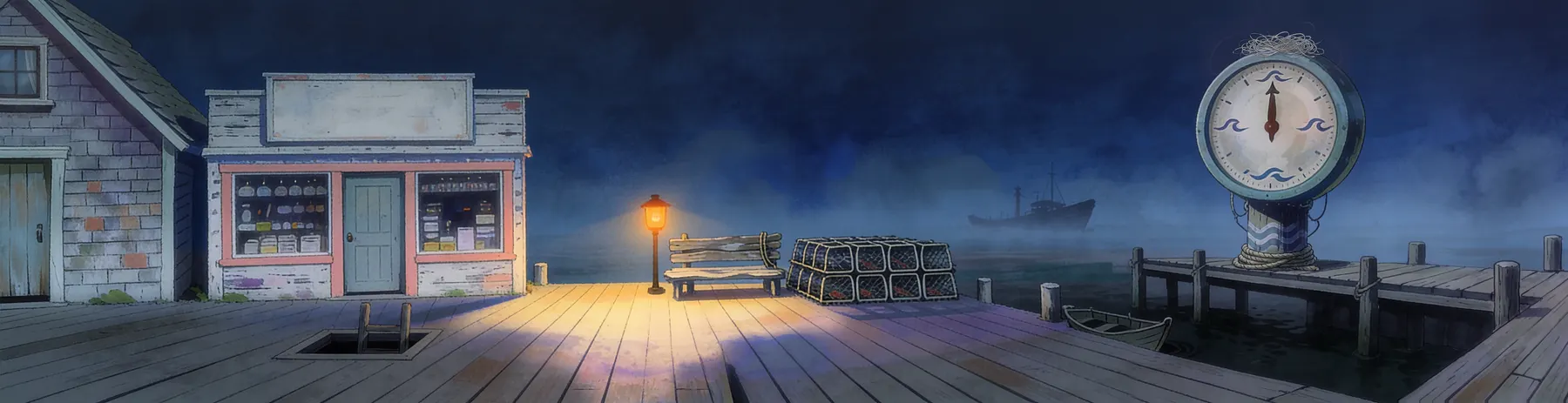
Four of the wharf's layers, each tagged with how fast it moves relative to the camera: the sky at 0.15, the foreground at 1.35.
Form HG-9
Section 8 · Determination
What worked, what didn't, what's left
The results so far, and the open risks.
Has worked
The compiled-design rule has held: the checker catches softlocks and shortcuts before a merge. One owner per file has kept parallel sessions from overwriting each other. Handovers make a session running out of context cost minutes, not a day. Art for six rooms and the cast cost $20.80, cheap enough to throw samples away.
Hasn't
The cut-out rig. Music, which is parked. Hints: the sessions over-explained puzzles until Jeff's playtest caught it, and the fix became a checker rule. Memory: the phone found a problem the desktop didn't.
Not yet retired
No music yet. The game has been played by its maker and a solver, not by strangers. Generated art still needs a human eye, because the gates only catch what they're told to look for. Sound and a wider playtest are still ahead.